
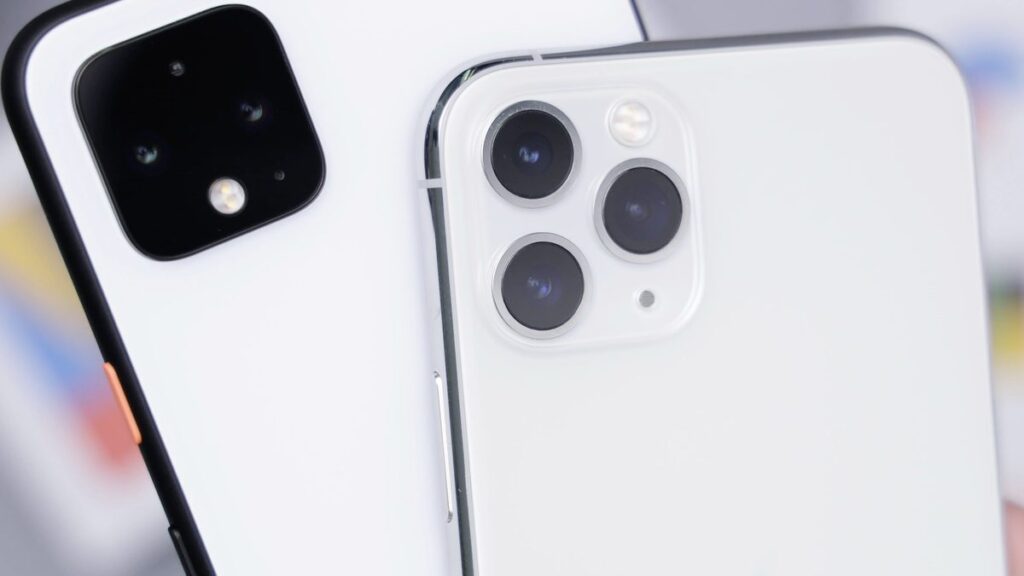
Photograph the same street, at the same moment, with two modern phones, and you will get two different pictures. Not slightly different: different in colour, in contrast, in how much of the sky survives, in whether the faces look like the people standing in front of you. This surprises people, because we still half-believe a camera records what is there. It does not, and phone cameras less than any other kind. What they produce is an argument about what the scene should look like, made by software, on your behalf, in a fraction of a second.
The sensor is small, and everything follows from that
A phone camera has to fit inside a body a few millimetres thick. That constrains the size of the sensor and the amount of light it can gather. Less light means a noisier raw signal, and a noisier signal means the picture you see cannot simply be the data that arrived. It has to be reconstructed.
This is why computational photography is not a gimmick bolted on top of a camera. It is the camera. The optics and sensor deliver a set of noisy, incomplete measurements; the processing pipeline turns them into an image. Two makers with near-identical hardware will still produce visibly different photographs, because the interesting decisions all happen after the shutter.
What actually happens when you press the button
On most modern phones, the moment you open the camera application the sensor begins capturing frames continuously into a buffer. Pressing the shutter does not start an exposure so much as select a moment from a stream already in progress. The device then combines several of those frames, often exposed differently, into one result. Several distinct judgements are made in the process.
Alignment and merging
Frames are aligned to compensate for hand movement, then merged to reduce noise. Anything that moved between frames, a passing cyclist, leaves in wind, a child, has to be detected and handled, usually by falling back to a single frame in that region. Different makers set different thresholds for what counts as motion, which is why one phone renders moving water as smooth and another as frozen droplets.
Tone mapping
Real scenes contain a far wider range of brightness than a screen can display. Tone mapping decides how to compress that range: how much shadow detail to lift, how much highlight to protect, how much local contrast to apply. This is the single largest cause of disagreement between devices. One maker lifts shadows aggressively so nothing is lost, producing a flat, evenly lit look. Another protects contrast, accepting genuinely dark shadows for a more dramatic image. Neither is wrong. They are different opinions about what a photograph is for.
White balance
The eye adapts to the colour of light so completely that we rarely notice it. A camera must estimate it. Under mixed lighting, a warm lamp near a cool window, there is no correct answer, only choices, and phones make different ones. This is why indoor photographs of the same room can come out cosy on one device and clinical on another.
Colour rendering
Beyond neutral accuracy, each maker applies a colour treatment: how saturated greens become, how skies are handled, how skin tones are protected. These are house styles, developed deliberately and defended internally, and they persist across generations. They are the closest thing phone photography has to the character of a particular film stock.
Sharpening and noise reduction
Noise reduction and detail retention pull against each other. Push noise reduction too far and fine texture, hair, foliage, fabric weave, dissolves into smooth patches. Push sharpening too far and you get crunchy edges and halos. Every pipeline sits somewhere on that continuum, and the choice is often tuned to look good on a phone screen rather than at full size.
Scene and subject detection
Most phones now identify what they are looking at and adjust accordingly: faces get different treatment from food, which gets different treatment from landscapes. Two devices that categorise the same scene differently will process it differently, which is why a photograph can change character when you shift the frame slightly and the classifier changes its mind.
Why the disagreement is getting larger, not smaller
You might expect these systems to converge as the underlying techniques mature. The opposite is happening, for a commercial reason. Sensor and lens hardware across the upper end of the market is increasingly similar, often from the same handful of suppliers. Processing is therefore the main place where a manufacturer can create a recognisable identity. The look is the product. Makers tune their pipelines so that a photograph is identifiable as having come from their device, and that incentive pushes styles apart rather than together.
What this means when you are choosing a phone
- Ignore megapixel counts almost entirely. Most high-resolution sensors combine groups of pixels by default anyway, and resolution has not been the limiting factor in phone image quality for a long time.
- Judge by looking at whole images, not crops. Sample comparisons that zoom to one hundred per cent measure sharpening policy, not photographic quality.
- Look at difficult scenes. Backlit portraits, indoor mixed lighting, night streets with bright signs. Easy daylight scenes look good on everything.
- Decide which house style you like. This is a genuine matter of taste and it will affect thousands of your photographs. Someone else declaring a camera the best is telling you about their preference.
- Check consistency across the lenses. Many phones have three cameras with three sensors, and the colour and processing can shift noticeably when the device switches between them mid-zoom. A phone that stays consistent is easier to live with than one with a stronger main camera and mismatched companions.
- Consider video separately. Video cannot use multi-frame merging in the same way and reveals the underlying hardware more honestly. A phone with excellent stills is not automatically good at video.
Getting a picture closer to what you saw
If the automatic result keeps disagreeing with your memory of a scene, there are practical remedies. Tapping to set exposure overrides some of the pipeline judgement. Most cameras offer a manual exposure adjustment after focusing, which is the quickest way to stop shadows being lifted into flatness. Shooting in the raw format, where available, hands you the unprocessed data and the responsibility that comes with it, useful for important photographs, tedious for everyday ones. And if a device offers a more neutral processing profile, it is usually worth trying for a week.
The deeper point is worth holding on to. A phone photograph is not a record of a scene; it is an interpretation produced by a system with opinions. Once you accept that, comparing cameras becomes much less confusing. You are not looking for the one that is accurate. You are looking for the one whose opinions you happen to share.